
NAME:
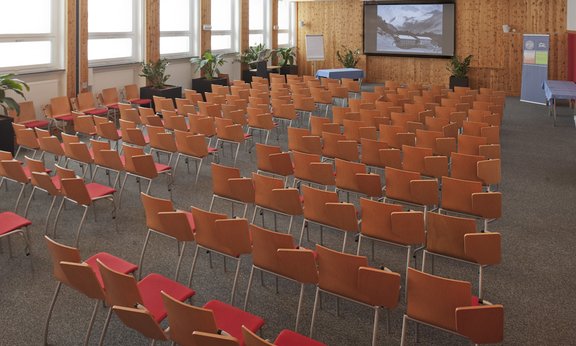
Großer Hörsaal
BUILDING:
UZ Obergurgl
FLOOR:
-1
TYPE:
Lecture Room
CAPACITY:
110
ACCESS:
Only Participants
EQUIPMENT:
---
Mountains store precipitation as snow and ice and release it with a delay that modulates seasonal and interannual variability. As glacier ice and snow cover decline under a warming climate, groundwater storage that feeds baseflow becomes an increasingly important buffer, sustaining rivers through dry periods. Yet conceptual glacio-hydrological models that reproduce the seasonal melt signal well, achieving high model performance scores, often represent baseflow poorly. This poor performance is most visible during the autumn recession and in winter, and could result from either the subsurface structure or the calibration strategy. To better understand how baseflow modelling could be improved, we use the Raven hydrological modelling framework, whose modular design allows us to change targeted parts of the model structure. Glacier runoff in our study is supplied to Raven by the Global Glacier Evolution Model (GloGEM) via one-way coupling. GloGEM uses snowline observations and geodetic mass balance to constrain both seasonal glacier processes (melt and accumulation) and long-term glacier evolution, reducing parameter equifinality and improving the reliability of glacier melt contributions to streamflow. We vary two structural choices in the hydrological model: the representation of the subsurface, and the glacier–groundwater connectivity, defined as what fraction of glacier melt passes through the subsurface storage rather than being routed to the stream directly. Each structure is calibrated by applying several multi-objective strategies, ranging from those targeting total discharge only to ones additionally considering MODIS snow cover and/or winter low flows as a measure of baseflow. In these high-elevation glacierized catchments, sustained sub-freezing winter temperatures suppress both rainfall and snowmelt. For this reason, cold-season streamflow is dominated by baseflow, and thus calibrating to winter low flows constrains the model’s subsurface response directly. We apply this framework across three climatically contrasting mountain regions: the temperate European Alps, the arid Upper Indus Basin, and the monsoon-influenced Eastern Himalaya. We ask whether groundwater-fed baseflow can be simulated primarily by explicitly targeting it in calibration or by added subsurface complexity, and whether this answer transfers across the three regions’ differing climates and glacier regimes.