
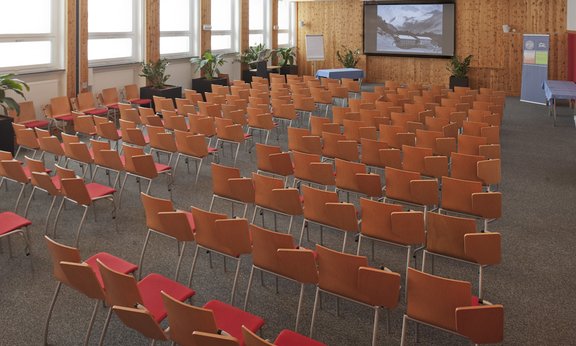
NAME:
Großer Hörsaal
BUILDING:
UZ Obergurgl
FLOOR:
-1
TYPE:
Lecture Room
CAPACITY:
110
ACCESS:
Only Participants
EQUIPMENT:
---
Forests create unique hydro-climatic conditions (“microclimates”) that can buffer climatic extremes such as heatwaves and droughts, thereby playing a critical role for diverse ecosystem functioning (e.g. clean water or buffering hydrological extremes), biodiversity, and overall forest resilience. However, the mechanisms, limits, and long-term stability of this climatic buffering capacity under ongoing climate change remain poorly understood and require interdisciplinary research approaches that integrate hydrological, meteorological, ecological, and sociological perspectives.
The “Future Forests” Cluster of Excellence at the University of Freiburg aims to investigate the current and future capacity of forests in providing essential socio-ecological services and to identify pathways towards resilient forest ecosystems capable of maintaining these functions under increasingly extreme climatic conditions. One core observational component of this research cluster is a dense wireless monitoring network designed to quantify and understand hydrological forested catchment conditions across the mountainous, pre-alpine Black Forest region. The network consists of more than 300 novel, IoT-based environmental stations measuring multiple environmental variables, including air temperature and humidity, precipitation or throughfall, snow depth, soil moisture, sap flux and growth of trees, CO2 concentrations, river discharge, water temperature and turbidity.
Here, we present the flexible, multi-scale and multi-parameter monitoring network design, based on a data-driven regionalization framework combining high-resolution environmental clustering to efficiently monitor the entire hydro-climatic variability over our >10.000 km² research domain. In additional to existing approaches, the framework allows to effectively combine different spatial scales (plots, forest stands and catchments) to find the optimal spatial location of catchments and sensor locations to capture the whole range of potential hydro-climatic and forest ecological processes in the selected region. This framework is transferable and designed as an open-source software that can be applied to various other environments and spatial scales. Beyond introducing the monitoring network design, we provide an outlook on how the combination of environmental observations, high-resolution structural forest data, and advanced modeling approaches will enable new insights into hydrological processes, including snow distribution, throughfall redistribution, and soil moisture across spatial scales.