
NAME:
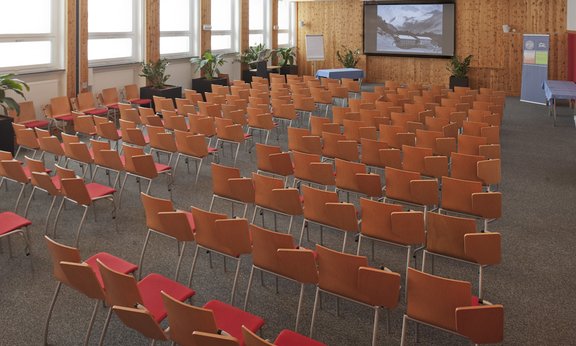
Großer Hörsaal
BUILDING:
UZ Obergurgl
FLOOR:
-1
TYPE:
Lecture Room
CAPACITY:
110
ACCESS:
Only Participants
EQUIPMENT:
---
Real-time hydrological and hydraulic forecasting systems are essential for supporting water resources management, flood risk mitigation, civil protection activities, and climate adaptation. Advances in environmental monitoring and computational capabilities now enable more accurate representation and prediction of watershed dynamics through innovative modelling approaches.
Within this context, the project “Analysis and implementation of innovative techniques for short- and medium-term hydrological forecasting to support the management of flood and water scarcity events in the Autonomous Province of Trento”, developed in collaboration with the University of Padova (TESAF) and the Risk Prevention Service and CUE of the Autonomous Province of Trento, aims to improve the understanding of the hydrological and hydraulic behaviour of the province’s river basins. The project includes the development of a digital twin of the regional hydrological system, capable of simulating key processes such as snow dynamics, soil moisture, evapotranspiration, river discharge, and water levels, together with the application of automatic calibration and validation techniques at hourly resolution. The study area encompasses the main watersheds of the Province of Trento, including the Adige River sub-basins (Avisio, Noce, Fersina, Leno, and Aviana), the Brenta River basin, the Cismon catchment, and the Sarca and Chiese River basins.
The modelling framework supports three main applications: (i) event-scale hydrological and hydraulic forecasting; (ii) long-term water balance assessments; and (iii) seasonal streamflow predictions up to six months ahead. Operating in real time at hourly resolution, the system also accounts for the influence of major reservoirs and their management rules on the hydrological cycle. Model outputs are provided at selected strategic nodes and delivered through a dedicated graphical interface connected to a real-time data acquisition and validation system.
This contribution presents the modelling framework and preliminary results for the Brenta River basin. The calibration and validation performance are evaluated at multiple control points, including major gauging stations and lake outlet sections. Results highlight the ability of the system to accurately reproduce observed hydrological dynamics across different spatial scales and hydrological conditions.