
NAME:
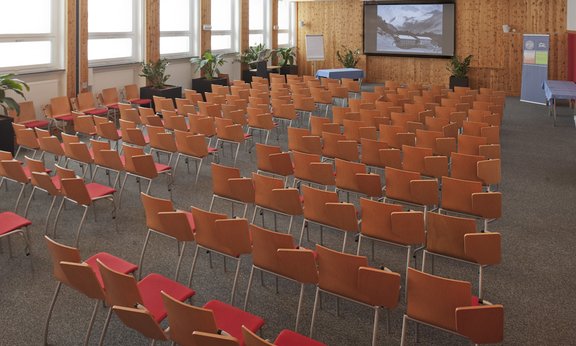
Großer Hörsaal
BUILDING:
UZ Obergurgl
FLOOR:
-1
TYPE:
Lecture Room
CAPACITY:
110
ACCESS:
Only Participants
EQUIPMENT:
---
Alpine (headwater) catchments are critical freshwater reservoirs, regulating streamflow and sustaining downstream ecosystems and human water supplies. However, the impacts of climate- and land cover change may modify hydrological process behavior in alpine headwater catchments and their relevance for the water availability in downstream areas. Elevation-dependent warming and shifts in snowfall, snow storage and rainfall regimes will alter streamflow towards higher winter discharge, earlier peak flows and more summer low-flow periods in these deglaciating environments. While the role of decreasing meltwater supply is understood fairly well, we need to further investigate the changing role of evapotranspiration (ET) under changing boundary conditions in terms of both climate and vegetation characteristics. The latter are, in fact, influenced not only by climate change but also by changes in the socio-economic practices. It is yet unknown which of these factors has the largest influence on the changing role of ET in these environments.
Here, we investigate the effects of coupled climate-vegetation scenarios on actual ET and its role on the water balance of the Fundusbach catchment (14 km²), which is a tributary catchment to the Ötztaler Ache. We apply a high resolution (25 m , 1 h) spatially distributed water balance model (WaSiM with an ensemble of ten parameter combinations), which allows for the investigation of the complex interactions between soil moisture, vegetation distribution and atmosphere, including potential changes in land use and management. Six bias-corrected EURO-CORDEX climate scenarios and four story-line based land-cover change scenarios are used as drivers for the hydrological model to simulate the potential future (2071-2100) impacts on the hydrological catchment processes as compared to the reference conditions (1971-2000).
While the study is still in the early stages of scenario application fist results already confirm increasing ET rates across all elevation and vegetation zones. While the highest absolute increases occur in densely forested areas, increasing actual ET rates in higher elevations limit lateral subsurface flow, leading to reduced water availability in the root zone at lower elevations. Following the persistent trend of land abandonment of high alpine pasture during recent decades, this effect could be even amplified by rapid shrub encroachment towards the natural treeline. Further investigations will quantify this effect and disentangle the specific contributions of climate versus vegetation change together with their associated uncertainties.