
NAME:
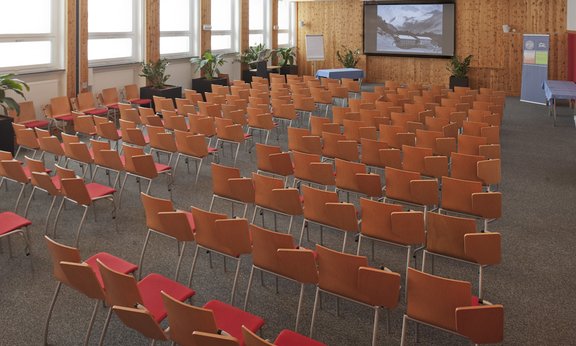
Großer Hörsaal
BUILDING:
UZ Obergurgl
FLOOR:
-1
TYPE:
Lecture Room
CAPACITY:
110
ACCESS:
Only Participants
EQUIPMENT:
---
Accurate representation of snow and ice processes is critical for hydrological modelling in high-alpine environments, where melt-dominated runoff generation governs water availability and hydropower reservoir inflows. While conceptual models offer computational efficiency through parsimonious approaches (e.g., temperature-index), their simplified process representations may inadequately capture the energy balance dynamics governing snowmelt timing, glacier melt, and runoff response, particularly at sub-daily temporal resolution.
This study investigates under which conditions increased model complexity yields meaningful improvements in predictive skill, comparing the standalone conceptual model COSERO against a coupled COSERO×Alpine3D configuration. In the coupled approach, the physically-based snowpack model Alpine3D simulates snow and glacier processes, while COSERO handles subsurface flows, lake evaporation, and runoff routing. The models are set up for two glacierized Austrian high-alpine catchments with active hydropower infrastructure (Maltatal and Zillertal) and run at hourly timestep over two decades, driven by gridded, undercatch-corrected precipitation, temperature and further meteorological inputs including incoming shortwave radiation, relative humidity, wind speed, and wind direction.
Model performance is evaluated across multiple target variables and hydrological signatures: overall water balance closure, reservoir inflow volumes, snowmelt amplitude and timing, and glacier melt contribution. This multi-criteria perspective allows a systematic assessment of where and when the added complexity of an energy-balance approach translates into improved process representation, and where the conceptual model proves sufficient. Preliminary results suggest that the coupled configuration offers advantages particularly during the snowmelt period, though the magnitude of improvement varies with target variable and catchment characteristics.